Beyond the primary collections, a small series of non-unique, editioned works exist in the Larva Labs catalog. These Editioned Works are limited, collaborative, and occasion-specific pieces. They share the same underlying class of algorithms as Autoglyphs, but operate outside the constraints that shaped them. Where Autoglyphs were compressed into the boundaries of a single blockchain transaction, these editions were freed from those limits.
The core, shared algorithm is based on the mathematics of modular fields, the same math that underpins much of modern cryptography.
In Autoglyphs, the fields’ values resolve to a small set of ASCII symbols, such as /, O, and +.
In each of the works that follow, the field’s values are used in a unique way.
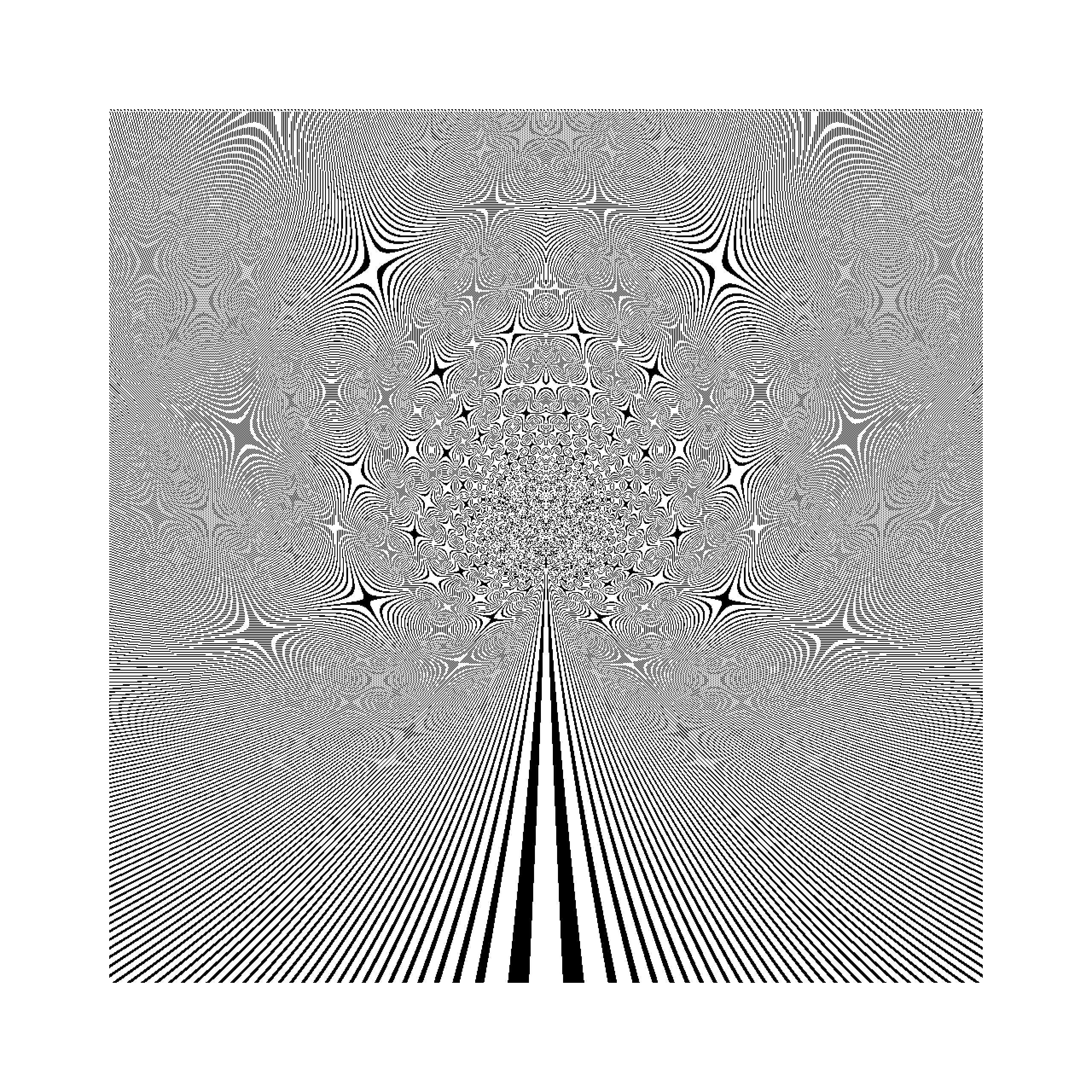
Before Autoglyphs had a name, the algorithm had predecessor outputs and prototypes. Protoglyph is the earliest surviving work in this family, made in the fall of 2018 and predating the formal development of the Autoglyphs.
The Protoglyph uses a complicated underlying function and, freed from the limits of a single blockchain transaction, operates at much higher resolution than the Autoglyphs. Each value of the field is reduced to a black or white pixel, so it is fundamentally pixel art. However, it has an illusory dimensionality produced by dense alternation between the black and white pixels. The result is organic and maximalist, in strong contrast to the cell-based Autoglyphs.
The work was released in 2022 as part of Proof’s Grails project, an anonymous drop format in which the identity of the artist was withheld at launch.
Hidden within the image itself, encoded in pixels of the work, was a message pointing to a yet-to-be-discovered puzzle embedded in the Meebits collection.
The mechanism: a row of tiny regular and inverted Ls along the top edge of Protoglyph reads, in binary ASCII, SECRET IS IN THE PIG NUMBERS, LL.
Of the 20,000 Meebits, only 64 are pigs in jerseys.
Concatenated as a hexadecimal string, those 64 jersey numbers form the private key for an Ethereum wallet which held a Meebit pig.
The puzzle was solved within days of the Protoglyph’s release and the winners took control of the wallet.1
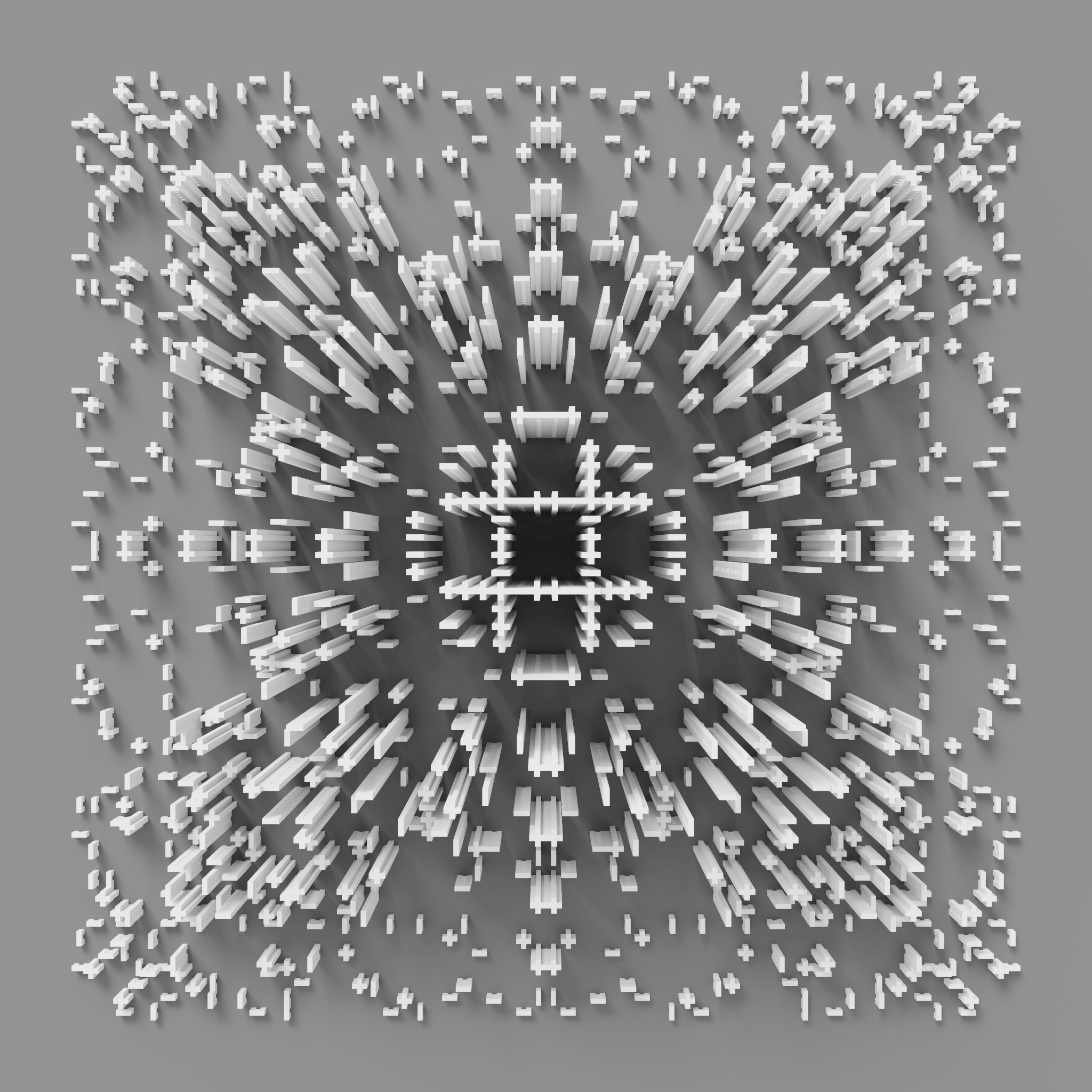
Voxelglyph is a collaboration with Fingerprints DAO, at the time the largest collector of Autoglyphs, made in 2022 to serve as their membership token. The work is based on Autoglyph #134, the center of which Fingerprints DAO used as their logo. To create the Voxelglyph, the two-dimensional Autoglyph algorithm was extended into a third dimension, with each pixel becoming a tower of voxels, volumetric cubes that occupy space rather than a flat square on a grid.
Each of 64 × 64 cells is assigned a vertical height in addition to its symbol, applying the same modular field arithmetic to produce a 3D structure. The goal was to turn the Autoglyph into something architectural. We explored several configurations before settling on something that reads almost as a small urban setting rendered as an architectural model.
The script is written in Java and stored entirely on-chain. Given the instructions and the source glyph, anyone with a Java runtime can render the work.2
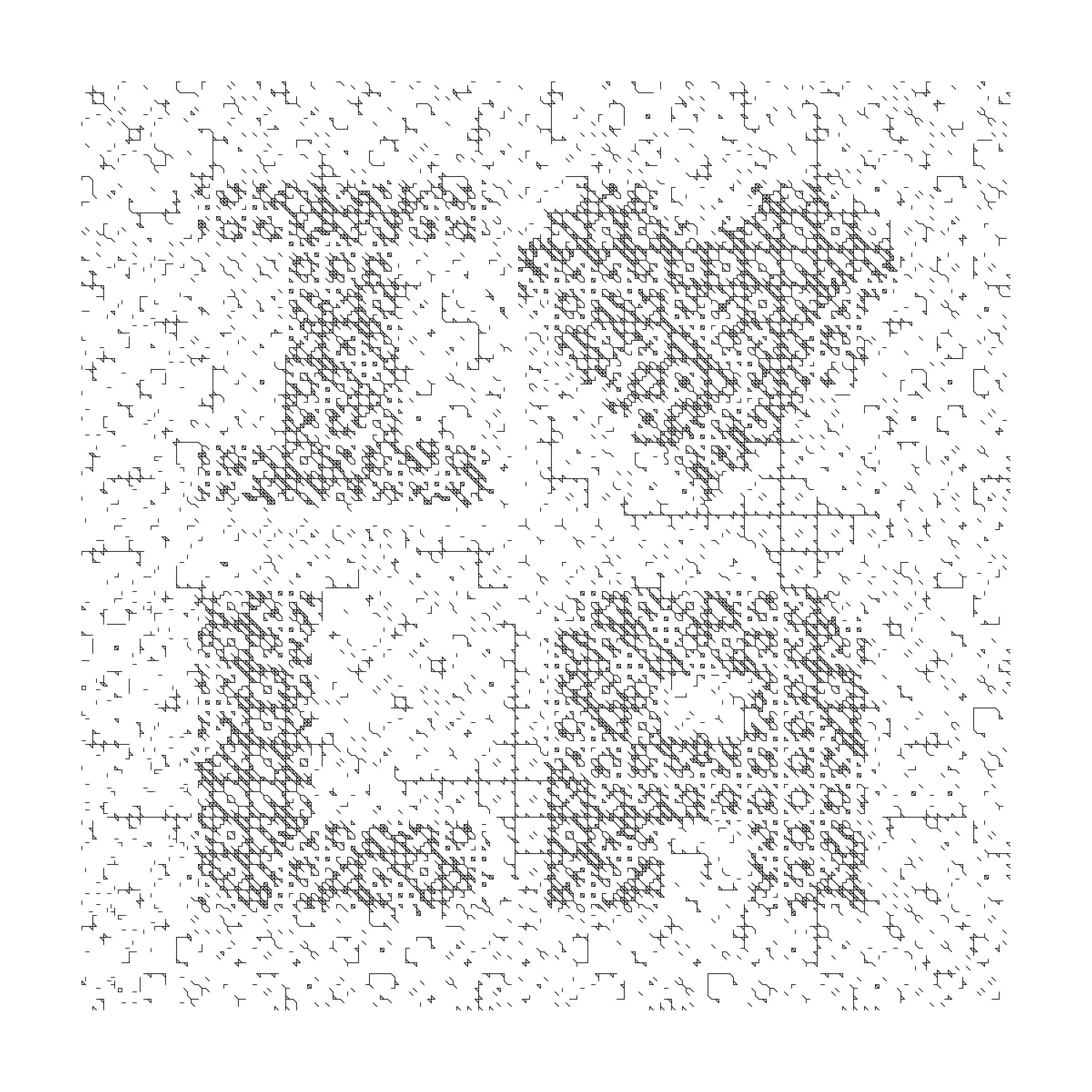
I ♥ LA was made in January 2025 in response to the Los Angeles wildfires, as part of a charitable initiative curated by mmERCH and its founder Colby Mugrabi.3
The series is an affected variant of the Autoglyph algorithm. The same fundamental generator operates underneath, but a black and white source image is introduced into the process as a modifier. At each cell, the threshold at which the algorithm draws a symbol is shifted by the corresponding value in the underlying image. The image effectively passes through the field and resolves on the other side. The text emerges from within the composition rather than being placed atop it, denser where the lettering sits and sparser where it does not.
Because the algorithm produces continuous lines rather than discrete glyphs (aka symbols), the work translates well on a plotter, and a few editions exist on paper.